Showing posts with label film review. Show all posts

27 September 2011

What Movies I've Been Watching Lately: The Gos and Some Poop

Bridesmaids (2011)

Bridesmaids is not a "female Hangover," but a film of complex characterization about a woman, Annie (Kristen Wiig), who feels that she's regressing further and further away from the adult ideal, while her best childhood friend (Maya Rudolph) has somehow become a real grown up and is getting married. The film does have its share of scenes dealing with bodily functions, but those are just box office dressing on a really sweet, subdued story about friendship and growing up.


What friendship looks like.

Most of the big comedic sequences stem from a rivalry between Wiig and one of the other bridesmaids (Rose Byrne) at the various pre-wedding gatherings. These other bridesmaid characters are not developed much beyond a sentence of back-story, but regardless of the title, this isn't a movie about Rudolph's wedding party. This is Annie's film, and Kristen Wiig carries it beautifully. She's not afraid to go broad during the "comedy moments," but otherwise Wiig plays Annie very subtly; excluding those fecal scenes, Bridesmaids is really very heartbreaking. Wiig has romantic interests in Jon Hamm and Chris O'Dowd, but this isn't a romantic comedy, either, and Annie, though flawed in her relationships with men, thankfully exists independently of them.

So just ignore the poop or embrace it, because wrapped up inside this big Hollywood romp is actually a rather touching film.


Drive (2011)

Drive has been compared to film noir, but is more reminiscent of a cheesy action movie as filmed by a Danish auteur.


Ryan Gosling is ruining my indie-crush cred.

Ryan Gosling plays Drive's stoic, unnamed protagonist, a daytime Hollywood stunt-driver, and get-away car man for hire. After exchanging rides home for longing looks with his harried waitress neighbor (Carey Mulligan), Gosling takes a job driving for this woman's ex-con husband, and becomes entangled in a bloody, messy world, of which he may or may not have previously been a part. The characterization does not extend much beyond these vague outlines of people—Gosling is good at driving and always wears a Scorpion jacket; Mulligan wants her son to be safe—but this seems intentional, as though director Nicolas Winding Refn is acknowledging that action film roles tend to be underdeveloped. Instead, Refn wisely focuses on mood, manufacturing intense, wordless scenes with 80's pop songs in place of dialogue; the center point always Gosling driving, tightly gripping the steering wheel and gazing ahead silently. When there is dialogue, especially that between the mob boss antagonists, it often feels clumsy and reiterates the faults of this genre Refn is seemingly subverting, but still not able to transcend.

Drive is a poetic film, but very violent and ultimately pointless. It's pretty to look at, but not any more impacting than most summer popcorn fare.


Lars and the Real Girl (2007)

Ryan Gosling is quiet loner Lars Lindstrom, for whom being touched burns and social interaction is a chore. Lars' neighbors—his brother (Paul Schneider) and sister-in-law (Emily Mortimer)—are elated when Lars not only comes over on his own accord, but gleefully shares that he has a female visitor named Bianca whom he met on the internet. Except she's an anatomically-correct sex doll. But Lars seemingly doesn't realize this, and expects everyone else to consider her as real as he does.


Melt.

Lars and the Real Girl could easily turn either very twee or crass, but is instead a sweet, sincere story of family and acceptance. Bianca is rarely used as a joke—more so the townspeople's reactions to her—and neither is Lars, who has Bianca stay in his brother's spare room, and does nothing dirtier with this sex doll than whisper that she looks pretty at breakfast. The small Midwestern town's positive reaction is a bit unbelievable, but Gosling sells it as Lars, making a compelling character out of this socially- and sexually-inept man, and keeping this strange, but endearing film from veering into preciousness.


50/50 (2011)


Interestingly, my friend officially stopped fancying J G-L after seeing this.

Early in 50/50, Adam Learner (Joseph Gordon-Levitt), recently-diagnosed with spinal cancer, is advised by his friend Kyle (Seth Rogen) to use his medical condition as a pick-up line. It works for Adam, but doesn't for 50/50, which employs its cancer tag to attract viewers to an ultimately uncompelling film about another twenty-something urban professional. Though Joseph Gordon-Levitt does his best with the role—and the rest of the superb cast with theirs—it is hard to feel anything for Adam: he's upper-middle class; has a good job at Seattle Public Radio; has supportive friends and family. The one sympathetic thing about this character is that he has cancer; his only other external struggles are that he can't drive and pushes people away.

Cancer is a shrewd plot choice to lure viewership, but like someone using a pick-up line, 50/50 routinely eschews any opportunities to make an emotional connection in favor of wooing the audience with one-liners and awkwardly-placed romance.

20 August 2011

Beetlejuice (Tim Burton, 1988) - Too Much of Too Many Good Things

I saw Beetlejuice once when I was about ten years old. Coupled with a few remembered wisps of plot threads from the short-lived animated series (something about a mall parking lot, another thing about Girl Scout cookies), all that I really remembered about it was the scene where they dance to the song from the Bon Marche commercials. Only recently, while IMDB-ing Alec Baldwin did I even realize he was in the movie.


The only scene I could recall

So it seems kind of ironic that Betelgeuse, titular star of the film and my memories, hardly features into this movie's story at all. The film really focuses on Adam and Barbara Maitland (Alec Baldwin and Geena Davis), recently deceased newlyweds, and their struggles to acclimate to the world of the dead, and to exorcise the big city Deetz family (Catherine O'Hara, Jeffrey Jones, and Winona Ryder) from their home. That realization of the afterlife is where Beetlejuice really succeeds, envisioning the world of the dead as a nightmarish bureaucracy, replete with dense rule books, interminable queues, and unhelpful caseworkers—like one hellish trip to the DMV. The late 80s claymation, model, and wire effects add a level of "realism" to this environment that CGI just can't (see: Casper); I want to stay in this movie, with these quaint ghosts who make miniature towns and have the same taste in clothing, furniture, and wallpaper as me forever. However, once the character Betelgeuse is added, everything gets a bit muddled.

Post-mortem Betelgeuse, as a "freelance bio-exorcist," is the answer the Maitland's think they need to have a peaceful, Deetz-free afterlife. They summon him, but he creeps them out, so they send him back, then he comes again, and etc. etc. The Betelgeuse plotline drags on for three quarters of the movie, ostensibly building tension but really just staying stagnant: the Maitland's think this Betelgeuse guy can help him, but it ends up he's bad news. Okay, we've got it. Let's get back to cutting some of that blood-red tape. But as Betelgeuse is posited as the antagonist, the film can't really go anywhere without him. Suddenly, in the third act, he wreaks havoc—abruptly forcing young Lydia Deetz to marry him (some regulation that was never previously mentioned), shooting some of Charles Deetz' wealthy business prospects through the ceiling, and yet all that is needed to stop him is someone to utter his name three times, which the characters seem to find impossibly hard. These conflicts feel intensely manufactured, for as soon as Betelgeuse leaves, the Maitlands and Deetzes find a way to cohabitate in harmony. Michael Keaton's energetic, hilarious performance distracts from this central plotting issue, but Betelgeuse, ironically enough, feels like he belongs in another movie. There is enough of a story with the Maitlands adjusting to the administration of the afterlife and their artsy new housemates, and the Betelgeuse-related plotlines trap this movie in a dramatic purgatory from which a crazy third act cannot wholly let it escape.

I love all the ideas that went into this movie: poltergeist caseworkers, ghosts cutting holes in sheets, sandworms, a bio-exorcist—but there are just a few too many floating around to make a truly great film.

22 June 2011

STEVE COOGAN: THE MAN WHO THINKS HE'S IT (1998) - Nothing New Here

Like Steve Coogan's previous live video, Live 'n' Lewd, The Man Who Thinks He's It shies away from Coogan's earlier impression-based stand-up, and instead showcases a number of comic characters: smutty shop girl Pauline Calf; nervous comedian Duncan Thickett; Portuguese pop sensation Tony Ferrino; unemployable drunkard Paul Calf; blunt, oblivious chat show host Alan Partridge; and the self-absorbed comedian Steve Coogan.

At the beginning of The Man, in one of its many faux-interviews with Steve Coogan in pretentious actor mode, Coogan vows that this show will be "different from all those other live videos." This promise is somewhat upheld, but at a loss for the viewers at home.


Coogan the Actor

By 1998, Coogan's The Man characters were all fairly well-established, having had their own series, shorts, or at least previous video appearances. For Alan Partridge, this meant having a well-known catchphrase and the expectation that he would get down to some chat, but for the other characters as well, a formula seemed to have developed for their stage performances. Pauline Calf, as she did in Live 'n' Lewd, crassly discusses her wanton lifestyle, and then reads an excerpt from her newest book. Duncan Thickett botches his attempts at the latest fads in comedy (including some meta "character comedy"). Tony Ferrino deplores matrimony, and then sings some songs winking at infidelity. Paul Calf drunkenly mumbles about unemployment and females. Alan Partridge has a chat and then sings a "medley" from a female vocalist's oeuvre (this time Kate Bush). This is quite a variety of very different performances, but for anyone familiar with Coogan's work, it's no surprise. A first-time viewer might giggle at the fact that crude Pauline Calf has written a book; a Coogan aficionado is just waiting to hear the name of her newest Mary-Sue character. Someone unfamiliar with Thickett might cackle at the fact that someone so out-of-touch is even attempting to do observational comedy; the well-versed viewer just wants to see what embarrassing bit of personal information he will give away in his attempts to relate with the audience. The characters themselves – much like Tony Ferrino's song selection – have become variations on a theme. Who will Paul Calf insult? Who will Alan Partridge awkwardly interview? These are humorous routines, but for a Coogan enthusiast, they are comfortable comedy, as comfy and familiar as sports casual clothing; nothing new or exciting here.

In order to fulfill that above-mentioned promise to be unlike other live shows, The Man Who Thinks He's It features many cut-aways to "Steve the Comedian," as well as bits with his fellow performers Julia Davis and Simon Pegg. The inclusion of co-performers is a key change from Live 'n' Lewd, and The Man depends heavily on them for its laughs. Julia Davis plays Pauline Calf's homely best friend, Tony Ferrino's soon-to-be-late wife, a feminist singer Paul Calf mistakenly invites to play a song, Alan Partridge's depressed, bulimic guest, and herself. Though Julia Davis is always a funny presence, rather than refresh Coogan's characters with some on-stage banter, her roles seem to just interrupt the sketches, and then drag them on without many actual jokes written for this interaction. With Paul Calf, Julia Davis performs a quintessential man-hating tune, and Paul just lazily dances around in the background. With these other characters to rely on, the center of the show – Coogan's creations – seem underwritten. The aforementioned same-old formula is used with a new friend in lieu of new jokes.

In their interview interstitials, Davis and Pegg paint a portrait of Coogan as a very self-obsessed, but desperate man. In one moment, overhearing Simon receiving big laughs while emceeing, Steve asks Simon not to tell that joke next time. This is a humorous poke at the egotism that comes with success, but it is also the only time we get to see Pegg in his emceeing role, unlike John Thomson as Bernard Righton in Live 'n' Lewd. With these frequent cutaways to documentary segments, once even interrupting Tony Ferrino mid-song, The Man Who Thinks He's It definitely does not feel like any other live show: it doesn't feel like a live show at all. The lampooning of the Comic Steve Coogan has become one of Coogan's funniest devices (in The Trip, Cock & Bull, Coffee & Cigarettes, etc.), but here, it's used almost too much. Like the addition of co-performers, the frequency of these documentary interstitials stops seeming refreshing and new, and starts to feel like a crutch to distract from an otherwise lackluster bill of performances.

In The Man Who Thinks He's It, Coogan is of course funny, but his characters (including "Steve Coogan" himself) have all had more hilarious, fresh, and enthusiastic performances. The Man showcases consistent, comfortable comedy, but you'll find nothing brilliant here.

17 June 2011

STEVE COOGAN: LIVE 'N' LEWD (1994) - Still Holds Up

In this 1994 live special, Coogan plays four of his characters (some less well-known than others): openly-polysexual townie Pauline Calf, nervous stand-up comedian Duncan Thickett, no-nonsense health and safety lecturer Ernest Moss, and the eternally-intoxicated wastrel Paul Calf.


Paul Calf's ratings certification at the beginning of the video.

A lot of the humour in these characters comes from knowing that in real life, Steve Coogan is a charming, handsome, funny man, yet he's dedicated himself to playing such unappealing roles. (Steve Coogan the Comedian is poked at with little "documentary" interstitials that bookend the show and fill the intermission.) Though all inherently depressing, there is a delicious variety to Coogan's comic creations, and whatever they lack in funny, they make up for in pure enthusiasm. With Pauline Calf, even if her slaggy "I've done him" mantra gets a bit trite, one cannot help but marvel at how convincing a woman Coogan makes — he's not pantomiming in drag; he's really transformed himself into a character who happens to be a lady. With awkward stand-up comedian Duncan Thickett, Coogan has perfected the "anti-performance": Thickett jumps about anxiously and constantly moves his hands, trying to compensate for his nervousness with an overzealous performance; he is a stage character totally not at ease with being on stage. Many of Thickett's laughs come from this Coogan / character juxtaposition: we know (even just from the Pauline Calf routine) that Coogan is a master of voices and jokes, yet Thickett is a terrible comedian, and a terrible impressionist. Occasionally Coogan allows Thickett an accurate impersonation, hilarious in that Duncan seems less realistic than his Neil Kinnock imitation. If ever a slow spot in these sketches, there's always comedy in trying to see Steve Coogan underneath his Ernest Moss glasses or Paul Calf haircut, yet the material itself is consistently hilarious.

The characters are each introduced by John Thomson as Bernard Righton, a surprisingly entertaining (yet staunchly politically correct) emcee. The video also contains the aforementioned "documentary" bits with Coogan as Coogan, as well as faux-interviews with audience and critics (Coogan and Thomson), and some pseudo-pedantic narration by Coogan as Terry Wogan. These interstitials make the video (which lacks but needs no narrative) feel interconnected and whole, like one linked comedy piece instead of the mishmash of disparate characters that it easily could have been.

For an early venture in Coogan's career, Live 'n' Lewd holds up very well, unlike Coogan's earliest, impression-based stand-up, which can now really only be viewed as the raw, cringe-worthy beginnings from which his later work ascended. Yes, his characters still invite comparison with Coogan the comic (then and now), but that was intentional at the time; someone with no external knowledge is provided a Coogan persona with which to juxtapose his roles. For an early piece with jokes that sometimes falter, that sort of self-awareness/-containment really gives a timeless quality to the video. Even if Steve Coogan had never gone on to do anything else, Live 'n' Lewd would still be a stand-up special worth watching.

30 May 2011

The Trip (2010) - Watch the TV Series Instead


The Trip, the television program, is a poignant, rambling, beautiful little series, starring comedians Steve Coogan and Rob Brydon as fictionalized versions of themselves. The Trip, the film, which I was able to catch at a packed SIFF screening, is an edited version of the television show. The six episode series clocks in at about 180 minutes, and the film, at 107 minutes, feels truncated and rushed comparatively. Both follow these hilarious gents as they review restaurants in the English countryside, but with those seventy-so minutes edited out, much of the nuance and poignancy is lost—the tone shifts from somber (but funny), to seemingly desperate for laughs. The film does often get those laughs (Coogan and Brydon, in their largely improvised conversations, are very humorous), but it fails to really make much impact beyond providing entertainment. The more melancholy scenes retained from the television series often feel tacked-on, and the transition between jokes and sentiment clunky, with quiet moments and breathing time largely cut out.

In the film and show, Steve Coogan expresses his desire to be acknowledged as more than just a comedic actor. He feels he could play more dramatic, serious, cinematic roles, but isn't offered those parts because of the success he's had doing goofy television comedy like Alan Partridge. "I don't want to do British TV," Coogan tells his agent when he's offered a guest spot as a Doctor Who baddy. "I want to be in films." Ironically, The Trip, the series, showcases one of Coogan's best dramatic performances to date—he's funny and real and heartbreaking, and all while on British television. The film, however, with its more frenetic pace, sacrificial cuts, and focus on jokes, seems to reinforce the impression Coogan is trying to escape—that he should just stick with broad comedy, and that subtlety is not really his thing. Coogan's BAFTA for his work on the show is well deserved, if inaccurately categorized as a "comedic" performance, but any accolades for the movie, beyond "best Michael Cain impersonation," would be unmerited due to the unfortunate editing choices.

Sadly, US audiences will unlikely be given a chance to legally view the series before a Region 1 DVD is released (if ever), and many of those familiar with Coogan or Brydon's work will no doubt go to see the film (it's been picked up by IFC), thus further separating Coogan from the dramatic recognition he rightfully deserves. Audiences looking for droll popcorn fare will not be disappointed, but those wanting to be genuinely moved should skip the flick and instead seek out the superlative television series, using whatever means they can.


The Trip was directed by Michael Winterbottom and written by Coogan and Brydon; the series was edited by Mags Arnold and Paul Monaghan (the film has no credited editor on IMDB); Claire Keelan (Nathan Barley) also stars.

11 December 2010

THE LITTLE THINGS: Election (Alexander Payne, 1999)

Election is one of those movies that I watched when I was about fifteen and knew was good, but did not quite appreciate its brilliance.

But it totally is - it's smart, it's funny, and it's about a high school student government election. As jaded as I've always been (I mean, I watched Daria in elementary school), I don't think a person can truly appreciate the absurdity of high school until they've left its hallowed halls. And goddamn man, people really do care about this pointless teenage academic bullshit, and Alexander Payne and co-writer Jim Taylor got that ridiculous kind of concern down.

Also there's some funny little things:


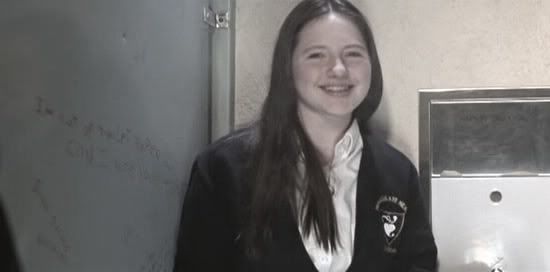
I hope that graffiti was just there. And that they chose that stall specifically because of it.


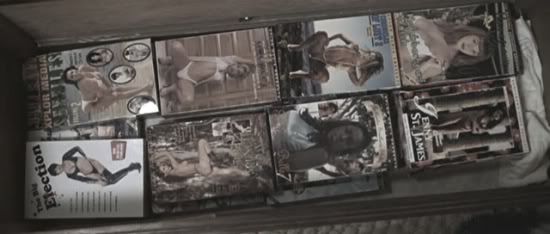
This is unrelated to the above screencap, but Tracy Flick's mom is Mrs. Vanderhoff from
Wayne's World - "I just opened my mouth and out it came." I like to ponder the possibility of those two characters being one, and how that would influence Tracy's upbringing.


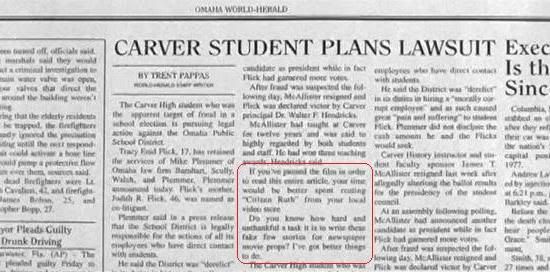
For those too lazy to google,
Citizen Ruth is another Payne/Taylor film, about abortion or something, starring the lady paleontologist from Jurassic Park. Not entirely certain I would take the effort to go out and actually rent a movie concerning Dr. Ellie Sattler's right to choose, but I might torrent it.


Also, in addition to having directed/co-written Sideways, Alexander Payne is an executive producer for the show Hung - the guy's really got a thing for lonely high school teachers.

21 November 2010

REVIEW: Extract (Mike Judge, 2009) — Pleasant, Vanilla Comedy

Extract, written and directed by Mike Judge (Office Space, King of the Hill, Beavis and Butt-Head) is a nice, amusing suburban comedy.

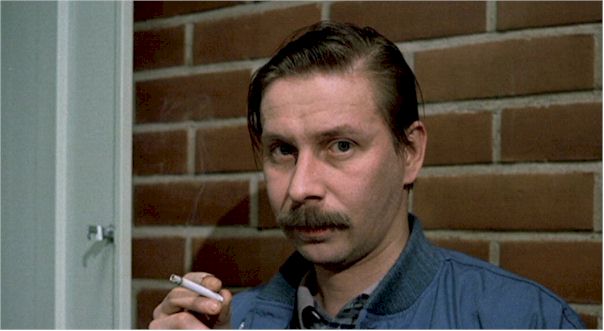
Jason Bateman (Arrested Development) plays chemist Joel Reynolds, founder and owner of Reynolds Extracts, and genuine lover of food flavoring. During work hours, Joel manages his plant and the colorful characters working there (including J.K. Simmons, Beth Grant (Mrs. Farmer from Donnie Darko), and a Matti Pellonpää-looking Mike Judge), and afterward hangs around with his wacky, drug-loving bartender friend Dean (a long-haired, bearded Ben Affleck in probably the only role I've actually enjoyed his performance). At home, Joel avoids his extra-neighborly next-door neighbor (David Koechner), and tries to figure out what to do with his sexless, though comfortable marriage to Suzie (Kristin Wiig).


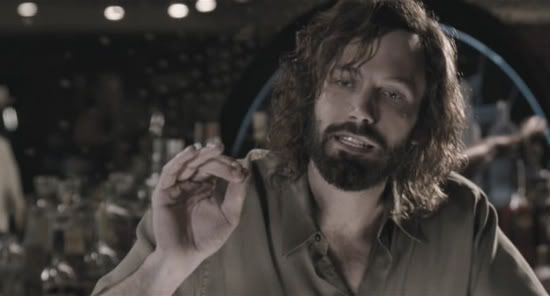
Gotta see it to believe it.

These are captivating characters, replete with lovable little details (Joel's wife designs coupons for a living), and Mike Judge obviously put a laborious amount of time and effort into establishing exactly who these people are. I really enjoyed my stay in this cinematic world, but I just didn't quite buy the plot.

Mila Kunis plays a con-lady who drifts into town in an attempt to get in on some settlement cash after an employee (Clifton Collins Jr.) gets injured at the extract factory. Joel takes her charm for actual interest and with the help of some of Dean's drugs, messes up both his work and personal life. I really like Joel, and the fact that he really likes extract, and Kunis' performance is convincing and convivial, but I just don't think this is the story for Reynolds Extracts. No one really grows or changes as this movie progresses; it's as stagnant as Joel's sex-life. Kunis' Other character just doesn't feel appropriate for this meticulously-crafted world. We don't need her. The lives of these characters are already interesting enough.

As shown by his creative portfolio, Mike Judge knows about blue- and white-collar monotony, and what it's like to be part of a family (I've seen more King of the Hill than I'd like to admit). But the thing about movies is that they're only about an hour and a half long. Unlike television, in which characters can have seasons in which to grow and interact with themselves and with Others, movies only have that ninety minutes, so the plot has to be as good as the people in it. Extract is an enjoyable movie, a pleasant movie that I wish were a television pilot. I want to see more of these characters, but the scenario Mike Judge has presented them in is as vanilla as the extract Joel feels so passionately about. As a program on the tube de boob, without Kunis' character, Extract could be on par with some of my favorite television pilots, but with her, this movie feels like a mundane mid-season episode.

I know King of the Hill got canceled, and The Goode Family didn't really work out, but come back to teevee, Mike Judge! And this time maybe just leave the cartooning to Seth MacFarlane and try your hand at the live action stuff. You've obviously got a knack for it.

09 November 2010

THE LITTLE THINGS: Honey, I Shrunk the Kids (Joe Johnston, 1989)

I found this inside of my Honey, I Shrunk the Kids VHS case:

(Click for bigger.)


Do you think I can still join?!

For all my love of VHS, that least practical of currently available mediums, it does restrict my ability to screencap. So without the still-frame proof, some trivia I credits-gleaned: H,ISTK was filmed in freaking Mexico! Not on a studio lot; those badass backyard special effects (the house-bits were filmed in San Diego) were just too expensive (or dangerous?) for these United States.

Dude.

Gives a whole new re-thinking to the term "our backyard." And to my childhood. And white suburban comedies. Which Honey, I Shrunk the Kids very much is.

The film could very easily be criticized for its ethnic homogeneity -- though I guess Rick Moranis could be considered Jewish -- as the central two families are staunchly of the Caucasian, heterosexual, nuclear type, and no supporting actors (one of whom is Lucy from Twin Peaks!) come from any other cultural groups. Yet for (white) kids and parents in late 1980s suburbia -- I'm presuming the film's intended demographic -- this was a non-issue. This was pre-Rodney King, pre-Princess and the Frog; this was my childhood, and back then you didn't take your kids to the movies for a lessen about racial tolerance. Maybe an intimation that jocks and geeks should just all get along would slip in, but we're stretching even at that.

Troubling demographic concerns aside, Honey, I Shrunk the Kids really works for the kind of movie that it is. It's actually better than I remember it being the last time I watched it (sometime in pre-teenhood). It's very funny, and the characters are relatively stock, but they're believable and heart-warming. This is probably attributable to the screenwriting presence of Tom Schulman (What About Bob?, Dead Poet's Society), whose oeuvre I haven't seen much of, but considering the rest of the creative crew, seems the only person this legitimate good quality can be pegged on. And I enjoy Schulman's writing, but oh man, those special effects! Late 80s/early 90s were the top of the pops for puppets and mechanical creatures. I love animation, but I am not a fan of its attempts to fill in for the real -- CGI, you are the pretentious, asshole cousin of animatronics. I am so jealous of the child actors and the Mexican crew for getting to be on that set and to interact with all those props. Because isn't that every kid's dream? To be not just small in people-terms (small in a way that gets you ignored and lacking of rights), but tiny, microscopic, Lilliputian tiny; to have an ant as a horse and a dewy blade of grass as a waterslide; to dive for sunken treasure in a fishtank; to use a spool of thread for a table and a thimble for a sieve; to worry about battling spiders but not about money or schoolwork or any of those concerns of the adult universe. Honey, I Shrunk the Kids visualizes that dream so fantastically that it can be pardoned for the goofiness of its plot (electronics magically work better if you smash them with baseballs?) and the sappiness of its requisite romance (the back of a Lego is my favorite place to make out, too) and the disturbingly frequent appearance of misogynistic comments in its dialogue. I don't really care that this movie does not accurately represent the scary reality of our modern world, because the world it creates is one I so wish I could be a part of.

Also, Rick Moranis is in it.

27 October 2010

REVIEW: United 93 -- like the LOST pilot, if it were composed entirely of unbearably tedious Jack and Kate scenes

I wrote this for a class, but then decided, hey! I wrote it! It's kind of short! It's kind of more an analysis than a review, but might as well post it here, too!

I've also added pictures.


Samuel Weber, in his article War, Terrorism, and Spectacle, writes that after the fall of the Twin Towers, US citizens had to be urged to "start spending again," to "get back to consuming," and in many ways this economic reinvigoration has emerged as a consumption of the tragedy itself. United 93 (Paul Greengrass, 2006) is one such consumer product. The film tells the story of United Flight 93, the fourth plane hijacked on September 11th, 2001, and the only one in which passengers were able to overpower the terrorists, and crash the plane far from the intended target.


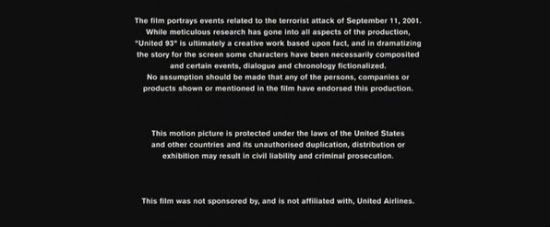
Feel free to judge the entire film based on this one image.

United 93 is imbued with "authenticity"; it is "a terse realistic depiction of ordinary people in extraordinary circumstances" (Žižek). In Slavoj Žižek's response to the film, he describes it as trying to be "as anti-Hollywood as possible": there are "no special effects, no grandiloquent heroic gestures" and "no glamorous stars" (except the post-2006 breakouts Olivia Thirlby (Juno, The Wackness, Bored to Death) and Cheyenne "Shy Action" Jackson (30 Rock)). The cinematography consists mainly of shaky hand-held camera-work. The set designers explicitly strived to capture the "feel" of 2001, with characters' hand-held technology as the prime indicator—doomed passengers tell their families they love them on old clamshell mobiles and airphones; a girl listens to a CD player; a woman comments on a fellow passenger's boxy laptop—"Is that the latest model?" Locations are captioned ("Northeast Air Defense Command Center, Rome, New York") as though they really are the places for which they are standing in. When the hijackings do finally occur, observers meet them less with panic than disbelief. Those reporting the hijacks have to repeatedly quell incredulity and questions of "Is this a sim?" with affirmations that no, "This is real world." These skeptical characters ask questions the audience would, so as characters are reassured, so, too, are viewers, of United 93's realism.


Shy Anne ain't shy on talent.

Žižek writes that this "avoiding of sensationalism," and "sober and restrained style"—this "touch of authenticity" should make viewers suspicious, as to "what ideological purposes it serves." But even more so, this meticulous authenticity and choice to present the movie as in "real-time"(a minute of screen-time is a minute of the viewer's time; no fades or ellipses) just makes the film boring. Whereas in a movie concerning fictional events, long stretches of mundanity could provide tension for what is to come, in United 93, even the least news-houndish of viewers already know what is going to happen. Greengrass's little attempts at foreshadowing—choosing to show an interminably long emergency exit demonstration instead of utilizing the only truncating editing device available (cutting to the just-as-dull military and airline control rooms)—and his efforts at creating tension, with furtive looks exchanged between the soon-to-be-terrorists, are rendered futile. These hijackers are presented not as a part of some incomprehensibly large and shady terrorist organization, but as "desperate and deranged individuals" (Weber), the violence they commit becoming a private matter. Thus as the terrorists are the only well-defined and therefore identifiable characters, the viewer comes to root for them, if just so that something will happen. This seems the reverse of the intended effect of any so patriotic a film, but could possibly be deliberate, so as to make the viewer feel ashamed of such thoughts, and therefore guilt-trip them into higher degrees of nationalism. But Greengrass, director of two of the Bourne films, does not merit the assumption of such subtle emotional prowess.


We may hate A-rabs, but we ain't no fuckin' racists.

Instead, as Weber writes, this seemingly-authentic spectacle allows the viewers to "identify with the ostensibly invulnerable perspective of the camera." The unavoidable, unanswerable question of who is filming these presented-as-real events only augments the camera's invincible position. Unlike television news media, in which subjects are very aware of the camera's existence within their space, United 93 is presented as though there is no one there filming it, and the viewer is voyeuristically watching these events occur right as they happen. The spectacle, and thus the spectator, is "at once here and elsewhere" (Weber). Elsewhere on United 93 as it is hijacked, but simultaneously here, in a theatre seat, safe to go home once the credits role, without the fatal ends of the actual passengers (there were no survivors, as told by a title card). The spectator thus feels triumphant, immortal. They have gone back in time and taken part in destroying these terrorists, and due to the obsessive degree of realism, they feel as though they know how this really happened (though in reality, there are no survivors to corroborate Greengrass's version of the events), and thus feel that they could easily deal with a hijacking themselves. This terrorism does not seem so unexpected anymore. All someone needs to quash it is enough confident, middle-class white male patriots to figure out a plan; just some hot water, knives, and forks—the available supplies on an everyday commercial flight.


Even extreme realism can't stand in for the truth. Thanks, credits!

Žižek asserts that with United 93, this disaster "turned into a kind of triumph" sustains the United State's need for "major catastrophe in order to resuscitate the spirit of communal solidarity." But even more so, this film (perhaps groundlessly) reestablishes that superior feeling destroyed when the Twin Towers were; that American idea that "it can't happen here." United 93 provides the United States with a post-9/11 update of that wholesome, very American mantra: "It can happen here, but we now know how to deal with it." A sign shown in the opening scenes of the film reads, "God bless America." And God bless America indeed, for with the false sense of security perpetuated by such cultural products as United 93, if ever a very real, non-privatized terror strikes, we are going to need all the benedictions we can get.


Notes:
-I realize the whole "privatized" terrorism argument is not very well developed, but if you'd read the articles we had to read, it kind of would be.
-Before accusing me of being heartless, I actually did tear up during the bit when people were calling their families. Though I did laugh when Shy Anne was all, "You believe me, don't you, Mom?"
-I've never seen the Bourne films but I'm assuming they're not "imbued" with much emotional depth. Matt Damon's been funny in 30 Rock, though, so I guess that's good, right?
-I also stopped watching LOST mid-way through season two, when they killed everybody I liked, so maybe new, even less bearable characters are introduced and I should give Kack some slack. But since I couldn't even get through the first couple of seasons even with the promise of Jeremy Davies come season five, I'm not sure even J.J. Abrams could come up with something so torturous.
-Then again, I've watched both Alias and Felicity… young Jeffrey Jacob really does have a talent for making his viewers want to stab out their corneas.
-Dude, but in LOST that one guy had a gun! So they could have just shot the terr'rists. But also they were flying from Australia, and even the smallest, least-notorious terrorist organizations are not that desperate.
-Also, the terr'rists were the only vaguely attractive actors in U93, so maybe I was a bit biased in my response.

Articles:
Slavoj Žižek, Five Years After: the Fire in the Minds of Men
Samuel Weber, War, terrorism, and spectacle: On Towers and Caves

16 October 2010

THE LITTLE THINGS: Gentlemen Broncos (Jared Hess, 2009)

This movie is okay. It derails into silliness and predictable jokes sometimes, but other times is infused with a brilliant, very enjoyable absurdity. It's about a kid whose sci-fi story is stolen by a well-known sci-fi novelist. Frustrating, though, is the fact the Hesses -- who with Napoleon Dynamite show they clearly understand how little others are interested in the concerns of society's rejects -- did not exploit the joke or acknowledge the reality that no one outside of a very small community would care about whether a science fiction writer has plagiarized. So much opportunity for hilarity, wasted!

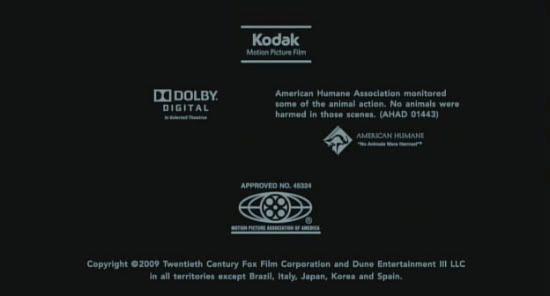
Yeah, but recently in conversation I referenced this detail in the end credits, so I've decided it probably needs to exist somewhere on the interwebs:


Very reassuring, AHA.

05 February 2010

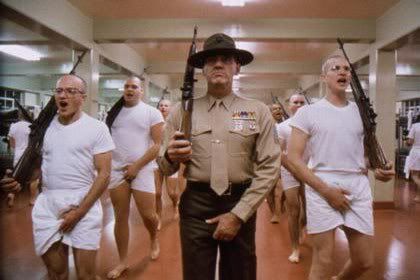
REVIEW: Full Metal Jacket -- I freakin' love this movie.

Yeah, yeah, I know -- this is the sort of movie you're supposed to watch in eighth grade and then fall madly in love with it. And yeah, yeah, if I had been enough of a cinephile to have seen it the first time when I was fourteen, then I probably would have watched it about forty subsequent times that year.

But I didn't. I'm lame, and only just watched the film for the first time recently, but I freakin' love Full Metal Jacket. I know, I know, it's Kubrick, it's so cliché to praise his work, but Full Metal Jacket is part self-reflexive Vietnam flick, part chillingly stark military-school fare, and 100% kick-ass. There's a reason why it's in the IMDb top 250.


Sure the "duality" of this film does not "gel" completely. There's potential for a ten-page analytical essay on that issue. We go from bleak, suicide-inducing cruelty in suburban America, to the wisecracking adventures of some ragtag marines, shooting VCs and calling each other "turd." If you like jokes making fun of racists that are also, you know, kind of racist, then you'll like this. But that's what makes Full Metal Jacket so awesome -- it's a war film that makes fun of war films. And all kinds of war films -- the ones about hard life at boot camp, those covering tough times in combat, and a little bit, even, of those stories of that supposed veteran sagacity that comes with having experienced battle, through Joker's sporadic, retrospective voice-over. There's even a whole section devoted to camera crews interviewing soldiers and "shooting" some action. Full Metal Jacket is a war movie that is in no way trying to fool you into thinking it isn't one. And come on, guys... it's Kubrick, and it's from 1987. If you haven't seen it yet, then get your ass in gear, man.