I saw Beetlejuice once when I was about ten years old. Coupled with a few remembered wisps of plot threads from the short-lived animated series (something about a mall parking lot, another thing about Girl Scout cookies), all that I really remembered about it was the scene where they dance to the song from the Bon Marche commercials. Only recently, while IMDB-ing Alec Baldwin did I even realize he was in the movie.
The only scene I could recall
So it seems kind of ironic that Betelgeuse, titular star of the film and my memories, hardly features into this movie's story at all. The film really focuses on Adam and Barbara Maitland (Alec Baldwin and Geena Davis), recently deceased newlyweds, and their struggles to acclimate to the world of the dead, and to exorcise the big city Deetz family (Catherine O'Hara, Jeffrey Jones, and Winona Ryder) from their home. That realization of the afterlife is where Beetlejuice really succeeds, envisioning the world of the dead as a nightmarish bureaucracy, replete with dense rule books, interminable queues, and unhelpful caseworkers—like one hellish trip to the DMV. The late 80s claymation, model, and wire effects add a level of "realism" to this environment that CGI just can't (see: Casper); I want to stay in this movie, with these quaint ghosts who make miniature towns and have the same taste in clothing, furniture, and wallpaper as me forever. However, once the character Betelgeuse is added, everything gets a bit muddled.
Post-mortem Betelgeuse, as a "freelance bio-exorcist," is the answer the Maitland's think they need to have a peaceful, Deetz-free afterlife. They summon him, but he creeps them out, so they send him back, then he comes again, and etc. etc. The Betelgeuse plotline drags on for three quarters of the movie, ostensibly building tension but really just staying stagnant: the Maitland's think this Betelgeuse guy can help him, but it ends up he's bad news. Okay, we've got it. Let's get back to cutting some of that blood-red tape. But as Betelgeuse is posited as the antagonist, the film can't really go anywhere without him. Suddenly, in the third act, he wreaks havoc—abruptly forcing young Lydia Deetz to marry him (some regulation that was never previously mentioned), shooting some of Charles Deetz' wealthy business prospects through the ceiling, and yet all that is needed to stop him is someone to utter his name three times, which the characters seem to find impossibly hard. These conflicts feel intensely manufactured, for as soon as Betelgeuse leaves, the Maitlands and Deetzes find a way to cohabitate in harmony. Michael Keaton's energetic, hilarious performance distracts from this central plotting issue, but Betelgeuse, ironically enough, feels like he belongs in another movie. There is enough of a story with the Maitlands adjusting to the administration of the afterlife and their artsy new housemates, and the Betelgeuse-related plotlines trap this movie in a dramatic purgatory from which a crazy third act cannot wholly let it escape.
I love all the ideas that went into this movie: poltergeist caseworkers, ghosts cutting holes in sheets, sandworms, a bio-exorcist—but there are just a few too many floating around to make a truly great film.
Showing posts with label movies. Show all posts
Showing posts with label movies. Show all posts

11 December 2010
THE LITTLE THINGS: Election (Alexander Payne, 1999)
Election is one of those movies that I watched when I was about fifteen and knew was good, but did not quite appreciate its brilliance.
But it totally is - it's smart, it's funny, and it's about a high school student government election. As jaded as I've always been (I mean, I watched Daria in elementary school), I don't think a person can truly appreciate the absurdity of high school until they've left its hallowed halls. And goddamn man, people really do care about this pointless teenage academic bullshit, and Alexander Payne and co-writer Jim Taylor got that ridiculous kind of concern down.
Also there's some funny little things:
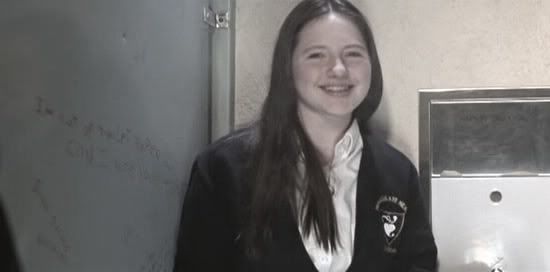
I hope that graffiti was just there. And that they chose that stall specifically because of it.
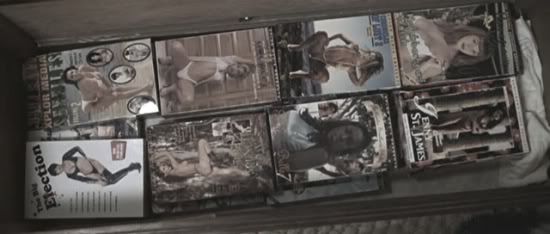
This is unrelated to the above screencap, but Tracy Flick's mom is Mrs. Vanderhoff from Wayne's World - "I just opened my mouth and out it came." I like to ponder the possibility of those two characters being one, and how that would influence Tracy's upbringing.
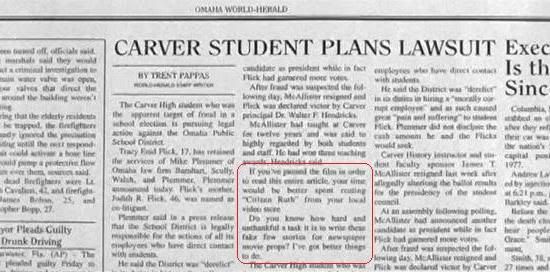
For those too lazy to google, Citizen Ruth is another Payne/Taylor film, about abortion or something, starring the lady paleontologist from Jurassic Park. Not entirely certain I would take the effort to go out and actually rent a movie concerning Dr. Ellie Sattler's right to choose, but I might torrent it.
Also, in addition to having directed/co-written Sideways, Alexander Payne is an executive producer for the show Hung - the guy's really got a thing for lonely high school teachers.
But it totally is - it's smart, it's funny, and it's about a high school student government election. As jaded as I've always been (I mean, I watched Daria in elementary school), I don't think a person can truly appreciate the absurdity of high school until they've left its hallowed halls. And goddamn man, people really do care about this pointless teenage academic bullshit, and Alexander Payne and co-writer Jim Taylor got that ridiculous kind of concern down.
Also there's some funny little things:
I hope that graffiti was just there. And that they chose that stall specifically because of it.
This is unrelated to the above screencap, but Tracy Flick's mom is Mrs. Vanderhoff from Wayne's World - "I just opened my mouth and out it came." I like to ponder the possibility of those two characters being one, and how that would influence Tracy's upbringing.
For those too lazy to google, Citizen Ruth is another Payne/Taylor film, about abortion or something, starring the lady paleontologist from Jurassic Park. Not entirely certain I would take the effort to go out and actually rent a movie concerning Dr. Ellie Sattler's right to choose, but I might torrent it.
Also, in addition to having directed/co-written Sideways, Alexander Payne is an executive producer for the show Hung - the guy's really got a thing for lonely high school teachers.
21 November 2010
REVIEW: Extract (Mike Judge, 2009) — Pleasant, Vanilla Comedy
Extract, written and directed by Mike Judge (Office Space, King of the Hill, Beavis and Butt-Head) is a nice, amusing suburban comedy.
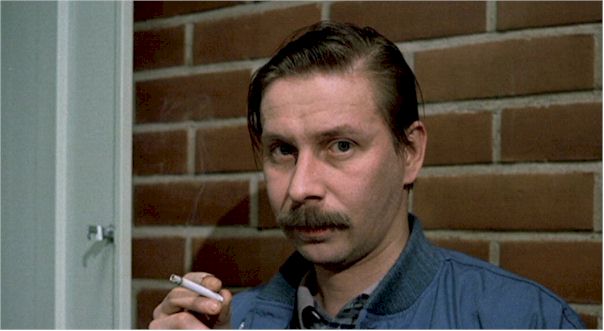
Jason Bateman (Arrested Development) plays chemist Joel Reynolds, founder and owner of Reynolds Extracts, and genuine lover of food flavoring. During work hours, Joel manages his plant and the colorful characters working there (including J.K. Simmons, Beth Grant (Mrs. Farmer from Donnie Darko), and a Matti Pellonpää-looking Mike Judge), and afterward hangs around with his wacky, drug-loving bartender friend Dean (a long-haired, bearded Ben Affleck in probably the only role I've actually enjoyed his performance). At home, Joel avoids his extra-neighborly next-door neighbor (David Koechner), and tries to figure out what to do with his sexless, though comfortable marriage to Suzie (Kristin Wiig).
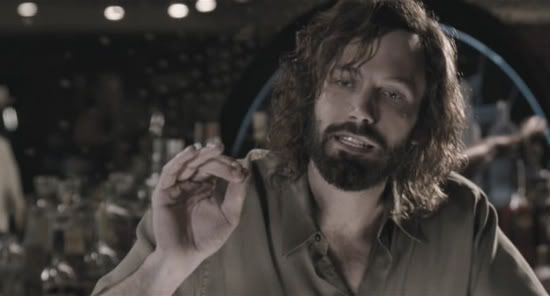
Gotta see it to believe it.
These are captivating characters, replete with lovable little details (Joel's wife designs coupons for a living), and Mike Judge obviously put a laborious amount of time and effort into establishing exactly who these people are. I really enjoyed my stay in this cinematic world, but I just didn't quite buy the plot.
Mila Kunis plays a con-lady who drifts into town in an attempt to get in on some settlement cash after an employee (Clifton Collins Jr.) gets injured at the extract factory. Joel takes her charm for actual interest and with the help of some of Dean's drugs, messes up both his work and personal life. I really like Joel, and the fact that he really likes extract, and Kunis' performance is convincing and convivial, but I just don't think this is the story for Reynolds Extracts. No one really grows or changes as this movie progresses; it's as stagnant as Joel's sex-life. Kunis' Other character just doesn't feel appropriate for this meticulously-crafted world. We don't need her. The lives of these characters are already interesting enough.
As shown by his creative portfolio, Mike Judge knows about blue- and white-collar monotony, and what it's like to be part of a family (I've seen more King of the Hill than I'd like to admit). But the thing about movies is that they're only about an hour and a half long. Unlike television, in which characters can have seasons in which to grow and interact with themselves and with Others, movies only have that ninety minutes, so the plot has to be as good as the people in it. Extract is an enjoyable movie, a pleasant movie that I wish were a television pilot. I want to see more of these characters, but the scenario Mike Judge has presented them in is as vanilla as the extract Joel feels so passionately about. As a program on the tube de boob, without Kunis' character, Extract could be on par with some of my favorite television pilots, but with her, this movie feels like a mundane mid-season episode.
I know King of the Hill got canceled, and The Goode Family didn't really work out, but come back to teevee, Mike Judge! And this time maybe just leave the cartooning to Seth MacFarlane and try your hand at the live action stuff. You've obviously got a knack for it.
Jason Bateman (Arrested Development) plays chemist Joel Reynolds, founder and owner of Reynolds Extracts, and genuine lover of food flavoring. During work hours, Joel manages his plant and the colorful characters working there (including J.K. Simmons, Beth Grant (Mrs. Farmer from Donnie Darko), and a Matti Pellonpää-looking Mike Judge), and afterward hangs around with his wacky, drug-loving bartender friend Dean (a long-haired, bearded Ben Affleck in probably the only role I've actually enjoyed his performance). At home, Joel avoids his extra-neighborly next-door neighbor (David Koechner), and tries to figure out what to do with his sexless, though comfortable marriage to Suzie (Kristin Wiig).
Gotta see it to believe it.
These are captivating characters, replete with lovable little details (Joel's wife designs coupons for a living), and Mike Judge obviously put a laborious amount of time and effort into establishing exactly who these people are. I really enjoyed my stay in this cinematic world, but I just didn't quite buy the plot.
Mila Kunis plays a con-lady who drifts into town in an attempt to get in on some settlement cash after an employee (Clifton Collins Jr.) gets injured at the extract factory. Joel takes her charm for actual interest and with the help of some of Dean's drugs, messes up both his work and personal life. I really like Joel, and the fact that he really likes extract, and Kunis' performance is convincing and convivial, but I just don't think this is the story for Reynolds Extracts. No one really grows or changes as this movie progresses; it's as stagnant as Joel's sex-life. Kunis' Other character just doesn't feel appropriate for this meticulously-crafted world. We don't need her. The lives of these characters are already interesting enough.
As shown by his creative portfolio, Mike Judge knows about blue- and white-collar monotony, and what it's like to be part of a family (I've seen more King of the Hill than I'd like to admit). But the thing about movies is that they're only about an hour and a half long. Unlike television, in which characters can have seasons in which to grow and interact with themselves and with Others, movies only have that ninety minutes, so the plot has to be as good as the people in it. Extract is an enjoyable movie, a pleasant movie that I wish were a television pilot. I want to see more of these characters, but the scenario Mike Judge has presented them in is as vanilla as the extract Joel feels so passionately about. As a program on the tube de boob, without Kunis' character, Extract could be on par with some of my favorite television pilots, but with her, this movie feels like a mundane mid-season episode.
I know King of the Hill got canceled, and The Goode Family didn't really work out, but come back to teevee, Mike Judge! And this time maybe just leave the cartooning to Seth MacFarlane and try your hand at the live action stuff. You've obviously got a knack for it.
09 November 2010
THE LITTLE THINGS: Honey, I Shrunk the Kids (Joe Johnston, 1989)
I found this inside of my Honey, I Shrunk the Kids VHS case:
(Click for bigger.)
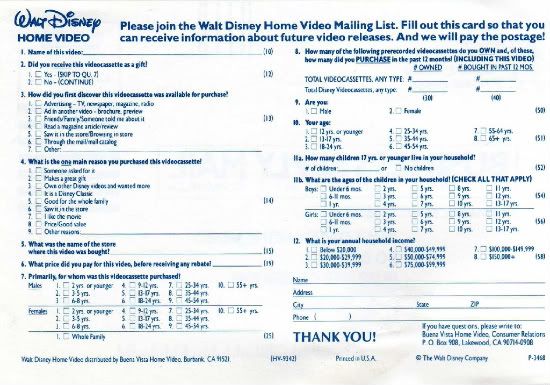
Do you think I can still join?!
For all my love of VHS, that least practical of currently available mediums, it does restrict my ability to screencap. So without the still-frame proof, some trivia I credits-gleaned: H,ISTK was filmed in freaking Mexico! Not on a studio lot; those badass backyard special effects (the house-bits were filmed in San Diego) were just too expensive (or dangerous?) for these United States.
Dude.
Gives a whole new re-thinking to the term "our backyard." And to my childhood. And white suburban comedies. Which Honey, I Shrunk the Kids very much is.
The film could very easily be criticized for its ethnic homogeneity -- though I guess Rick Moranis could be considered Jewish -- as the central two families are staunchly of the Caucasian, heterosexual, nuclear type, and no supporting actors (one of whom is Lucy from Twin Peaks!) come from any other cultural groups. Yet for (white) kids and parents in late 1980s suburbia -- I'm presuming the film's intended demographic -- this was a non-issue. This was pre-Rodney King, pre-Princess and the Frog; this was my childhood, and back then you didn't take your kids to the movies for a lessen about racial tolerance. Maybe an intimation that jocks and geeks should just all get along would slip in, but we're stretching even at that.
Troubling demographic concerns aside, Honey, I Shrunk the Kids really works for the kind of movie that it is. It's actually better than I remember it being the last time I watched it (sometime in pre-teenhood). It's very funny, and the characters are relatively stock, but they're believable and heart-warming. This is probably attributable to the screenwriting presence of Tom Schulman (What About Bob?, Dead Poet's Society), whose oeuvre I haven't seen much of, but considering the rest of the creative crew, seems the only person this legitimate good quality can be pegged on. And I enjoy Schulman's writing, but oh man, those special effects! Late 80s/early 90s were the top of the pops for puppets and mechanical creatures. I love animation, but I am not a fan of its attempts to fill in for the real -- CGI, you are the pretentious, asshole cousin of animatronics. I am so jealous of the child actors and the Mexican crew for getting to be on that set and to interact with all those props. Because isn't that every kid's dream? To be not just small in people-terms (small in a way that gets you ignored and lacking of rights), but tiny, microscopic, Lilliputian tiny; to have an ant as a horse and a dewy blade of grass as a waterslide; to dive for sunken treasure in a fishtank; to use a spool of thread for a table and a thimble for a sieve; to worry about battling spiders but not about money or schoolwork or any of those concerns of the adult universe. Honey, I Shrunk the Kids visualizes that dream so fantastically that it can be pardoned for the goofiness of its plot (electronics magically work better if you smash them with baseballs?) and the sappiness of its requisite romance (the back of a Lego is my favorite place to make out, too) and the disturbingly frequent appearance of misogynistic comments in its dialogue. I don't really care that this movie does not accurately represent the scary reality of our modern world, because the world it creates is one I so wish I could be a part of.
Also, Rick Moranis is in it.
(Click for bigger.)
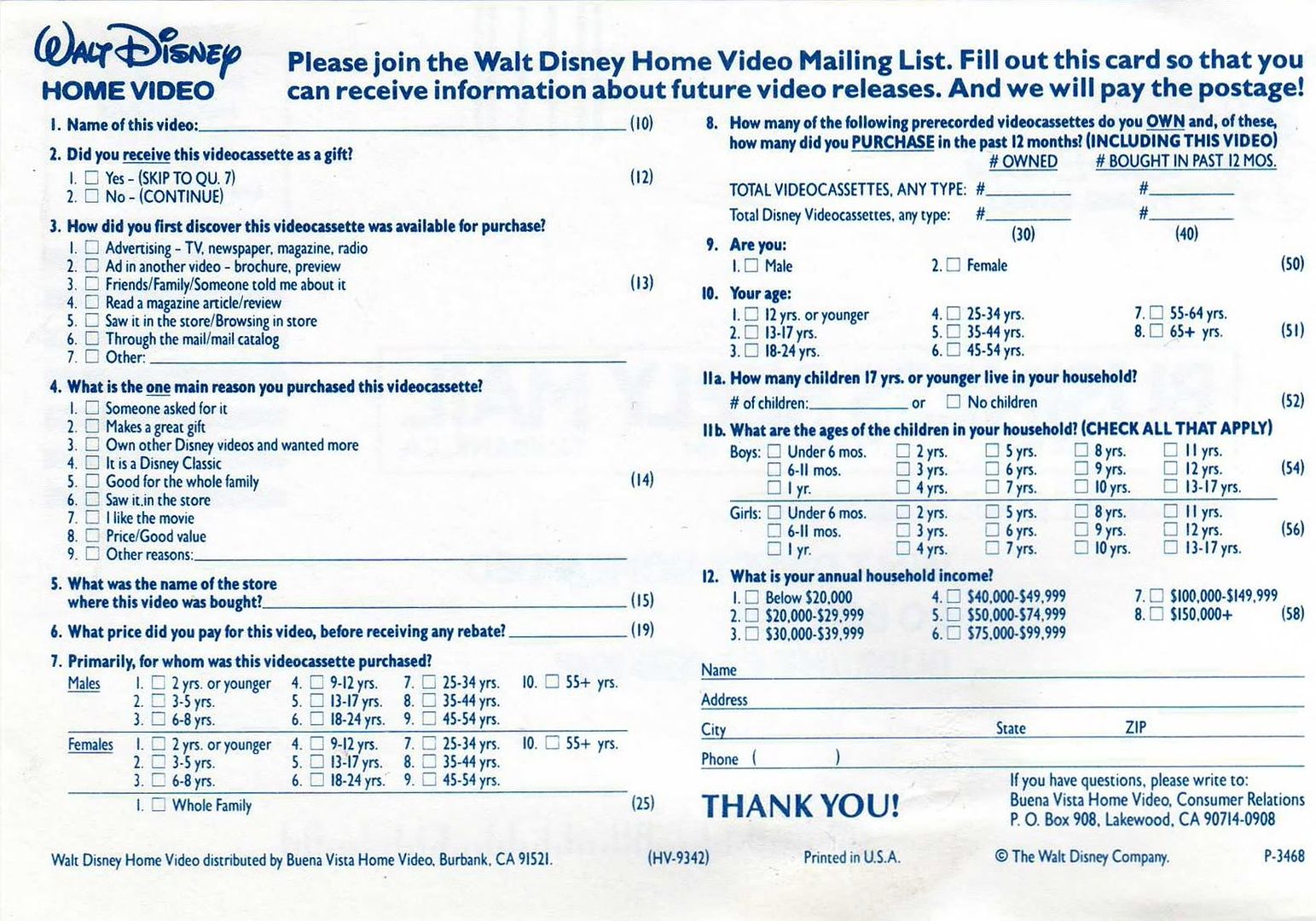
Do you think I can still join?!
For all my love of VHS, that least practical of currently available mediums, it does restrict my ability to screencap. So without the still-frame proof, some trivia I credits-gleaned: H,ISTK was filmed in freaking Mexico! Not on a studio lot; those badass backyard special effects (the house-bits were filmed in San Diego) were just too expensive (or dangerous?) for these United States.
Dude.
Gives a whole new re-thinking to the term "our backyard." And to my childhood. And white suburban comedies. Which Honey, I Shrunk the Kids very much is.
The film could very easily be criticized for its ethnic homogeneity -- though I guess Rick Moranis could be considered Jewish -- as the central two families are staunchly of the Caucasian, heterosexual, nuclear type, and no supporting actors (one of whom is Lucy from Twin Peaks!) come from any other cultural groups. Yet for (white) kids and parents in late 1980s suburbia -- I'm presuming the film's intended demographic -- this was a non-issue. This was pre-Rodney King, pre-Princess and the Frog; this was my childhood, and back then you didn't take your kids to the movies for a lessen about racial tolerance. Maybe an intimation that jocks and geeks should just all get along would slip in, but we're stretching even at that.
Troubling demographic concerns aside, Honey, I Shrunk the Kids really works for the kind of movie that it is. It's actually better than I remember it being the last time I watched it (sometime in pre-teenhood). It's very funny, and the characters are relatively stock, but they're believable and heart-warming. This is probably attributable to the screenwriting presence of Tom Schulman (What About Bob?, Dead Poet's Society), whose oeuvre I haven't seen much of, but considering the rest of the creative crew, seems the only person this legitimate good quality can be pegged on. And I enjoy Schulman's writing, but oh man, those special effects! Late 80s/early 90s were the top of the pops for puppets and mechanical creatures. I love animation, but I am not a fan of its attempts to fill in for the real -- CGI, you are the pretentious, asshole cousin of animatronics. I am so jealous of the child actors and the Mexican crew for getting to be on that set and to interact with all those props. Because isn't that every kid's dream? To be not just small in people-terms (small in a way that gets you ignored and lacking of rights), but tiny, microscopic, Lilliputian tiny; to have an ant as a horse and a dewy blade of grass as a waterslide; to dive for sunken treasure in a fishtank; to use a spool of thread for a table and a thimble for a sieve; to worry about battling spiders but not about money or schoolwork or any of those concerns of the adult universe. Honey, I Shrunk the Kids visualizes that dream so fantastically that it can be pardoned for the goofiness of its plot (electronics magically work better if you smash them with baseballs?) and the sappiness of its requisite romance (the back of a Lego is my favorite place to make out, too) and the disturbingly frequent appearance of misogynistic comments in its dialogue. I don't really care that this movie does not accurately represent the scary reality of our modern world, because the world it creates is one I so wish I could be a part of.
Also, Rick Moranis is in it.
06 November 2010
THE LITTLE THINGS: Knocked Up (Judd Apatow, 2007)
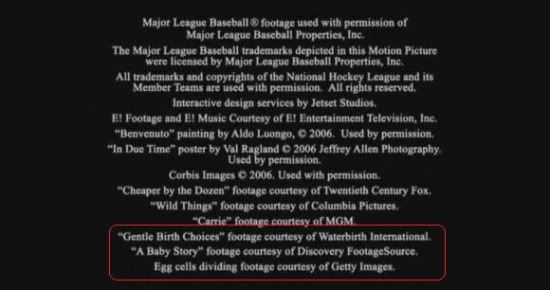
I just thought it was funny to think about Getty Images having stock footage of egg cells dividing. This leads to so many questions...
Whose - or what's - egg was it? Did that zygote grow up to be something that got a chance for its own egg cells to divide? Who filmed this? Who would agree to let this be filmed? How did Getty Images go about acquiring this footage? What would be written on the invoice? How much did Judd pay to use this footage? Yeah, uh, answered that question myself and it's around, let's say, $2,800. You decide whether it was worth it for any of the parties involved. (Hint: it was for Getty Images.) Please shut up, brain.
31 October 2010
THE WRONG THINGS: Ghostbusters (Ivan Reitman, 1984)
Often, while watching movies or teevee, instead of paying attention to important things like the storyline or character development or editing patterns or soundtrack choices, or even looking at distracting little background details, I find myself fixating on the wrong things, namely, the costuming. This doesn't happen a lot during contemporary productions -- especially network dramedies, not that I've watched many of those* -- which regularly seem to assume the role of "fashion" show more than anything, but instead during non-period, older films, set during the time during which they were made. Like Ghostbusters.
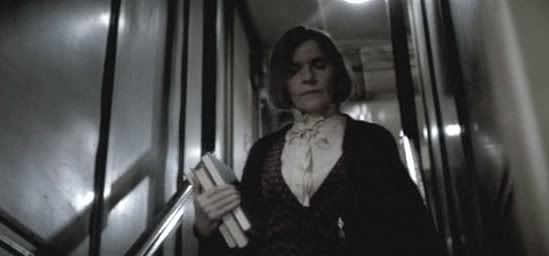
The modifier in "sexy librarian" is just redundant.
Man, I love how people dressed in the late seventies and early eighties.
But sadly, at this time, I don't have the money or means** with which to acquire such outfits. So I'll just post screencaps of them instead.
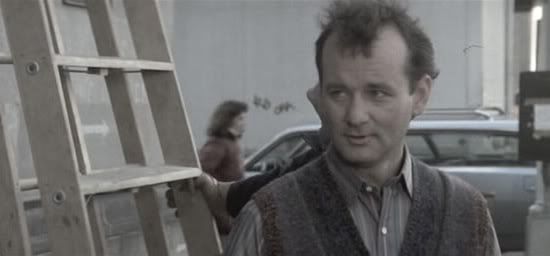
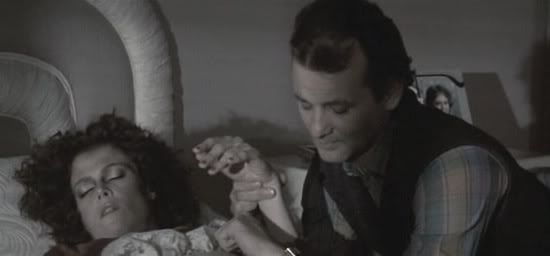
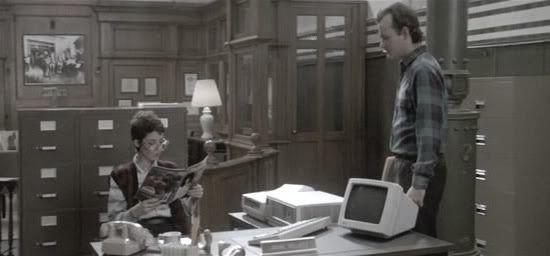
There weren't many opportunities for good frame grabs, but Bill Murray, when not suited up, was really rocking that plaid shirt/woolly vest look. Worked for Janine, too, but the hipsters have already claimed her giant glasses, so I'm not even going to try for a Melnitz and instead, in that future dreamland in which my disposable income reaches the double digits, put my energy into pursuing my own Dr. Vestman look. You see what I did there?
*I was in seventh grade! You're allowed to like The OC and Gilmore Girls when you're thirteen! And I only bought the DVD boxsets because of nostalgia, not because I secretly still have a crush on young Adam Brody or anything. That would be ridiculous.
**Ebay/time machine (go back to 1979, and buy that vintage shit when it was new! -- and don't worry, I've already started collecting old school dollar bills)
The modifier in "sexy librarian" is just redundant.
Man, I love how people dressed in the late seventies and early eighties.
But sadly, at this time, I don't have the money or means** with which to acquire such outfits. So I'll just post screencaps of them instead.
There weren't many opportunities for good frame grabs, but Bill Murray, when not suited up, was really rocking that plaid shirt/woolly vest look. Worked for Janine, too, but the hipsters have already claimed her giant glasses, so I'm not even going to try for a Melnitz and instead, in that future dreamland in which my disposable income reaches the double digits, put my energy into pursuing my own Dr. Vestman look. You see what I did there?
*I was in seventh grade! You're allowed to like The OC and Gilmore Girls when you're thirteen! And I only bought the DVD boxsets because of nostalgia, not because I secretly still have a crush on young Adam Brody or anything. That would be ridiculous.
**Ebay/time machine (go back to 1979, and buy that vintage shit when it was new! -- and don't worry, I've already started collecting old school dollar bills)
27 October 2010
REVIEW: United 93 -- like the LOST pilot, if it were composed entirely of unbearably tedious Jack and Kate scenes
I wrote this for a class, but then decided, hey! I wrote it! It's kind of short! It's kind of more an analysis than a review, but might as well post it here, too!
I've also added pictures.
Samuel Weber, in his article War, Terrorism, and Spectacle, writes that after the fall of the Twin Towers, US citizens had to be urged to "start spending again," to "get back to consuming," and in many ways this economic reinvigoration has emerged as a consumption of the tragedy itself. United 93 (Paul Greengrass, 2006) is one such consumer product. The film tells the story of United Flight 93, the fourth plane hijacked on September 11th, 2001, and the only one in which passengers were able to overpower the terrorists, and crash the plane far from the intended target.
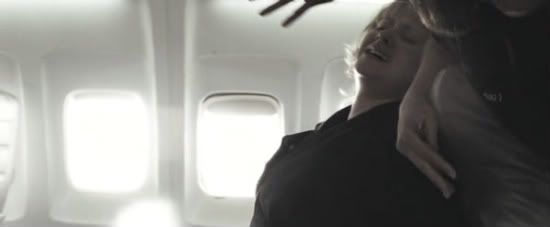
Feel free to judge the entire film based on this one image.
United 93 is imbued with "authenticity"; it is "a terse realistic depiction of ordinary people in extraordinary circumstances" (Žižek). In Slavoj Žižek's response to the film, he describes it as trying to be "as anti-Hollywood as possible": there are "no special effects, no grandiloquent heroic gestures" and "no glamorous stars" (except the post-2006 breakouts Olivia Thirlby (Juno, The Wackness, Bored to Death) and Cheyenne "Shy Action" Jackson (30 Rock)). The cinematography consists mainly of shaky hand-held camera-work. The set designers explicitly strived to capture the "feel" of 2001, with characters' hand-held technology as the prime indicator—doomed passengers tell their families they love them on old clamshell mobiles and airphones; a girl listens to a CD player; a woman comments on a fellow passenger's boxy laptop—"Is that the latest model?" Locations are captioned ("Northeast Air Defense Command Center, Rome, New York") as though they really are the places for which they are standing in. When the hijackings do finally occur, observers meet them less with panic than disbelief. Those reporting the hijacks have to repeatedly quell incredulity and questions of "Is this a sim?" with affirmations that no, "This is real world." These skeptical characters ask questions the audience would, so as characters are reassured, so, too, are viewers, of United 93's realism.

Shy Anne ain't shy on talent.
Žižek writes that this "avoiding of sensationalism," and "sober and restrained style"—this "touch of authenticity" should make viewers suspicious, as to "what ideological purposes it serves." But even more so, this meticulous authenticity and choice to present the movie as in "real-time"(a minute of screen-time is a minute of the viewer's time; no fades or ellipses) just makes the film boring. Whereas in a movie concerning fictional events, long stretches of mundanity could provide tension for what is to come, in United 93, even the least news-houndish of viewers already know what is going to happen. Greengrass's little attempts at foreshadowing—choosing to show an interminably long emergency exit demonstration instead of utilizing the only truncating editing device available (cutting to the just-as-dull military and airline control rooms)—and his efforts at creating tension, with furtive looks exchanged between the soon-to-be-terrorists, are rendered futile. These hijackers are presented not as a part of some incomprehensibly large and shady terrorist organization, but as "desperate and deranged individuals" (Weber), the violence they commit becoming a private matter. Thus as the terrorists are the only well-defined and therefore identifiable characters, the viewer comes to root for them, if just so that something will happen. This seems the reverse of the intended effect of any so patriotic a film, but could possibly be deliberate, so as to make the viewer feel ashamed of such thoughts, and therefore guilt-trip them into higher degrees of nationalism. But Greengrass, director of two of the Bourne films, does not merit the assumption of such subtle emotional prowess.

We may hate A-rabs, but we ain't no fuckin' racists.
Instead, as Weber writes, this seemingly-authentic spectacle allows the viewers to "identify with the ostensibly invulnerable perspective of the camera." The unavoidable, unanswerable question of who is filming these presented-as-real events only augments the camera's invincible position. Unlike television news media, in which subjects are very aware of the camera's existence within their space, United 93 is presented as though there is no one there filming it, and the viewer is voyeuristically watching these events occur right as they happen. The spectacle, and thus the spectator, is "at once here and elsewhere" (Weber). Elsewhere on United 93 as it is hijacked, but simultaneously here, in a theatre seat, safe to go home once the credits role, without the fatal ends of the actual passengers (there were no survivors, as told by a title card). The spectator thus feels triumphant, immortal. They have gone back in time and taken part in destroying these terrorists, and due to the obsessive degree of realism, they feel as though they know how this really happened (though in reality, there are no survivors to corroborate Greengrass's version of the events), and thus feel that they could easily deal with a hijacking themselves. This terrorism does not seem so unexpected anymore. All someone needs to quash it is enough confident, middle-class white male patriots to figure out a plan; just some hot water, knives, and forks—the available supplies on an everyday commercial flight.
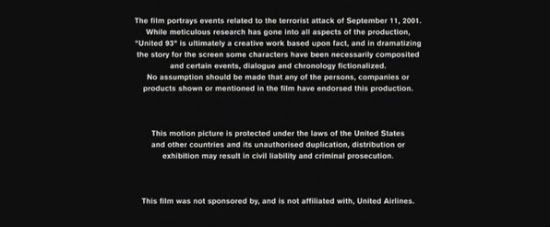
Even extreme realism can't stand in for the truth. Thanks, credits!
Žižek asserts that with United 93, this disaster "turned into a kind of triumph" sustains the United State's need for "major catastrophe in order to resuscitate the spirit of communal solidarity." But even more so, this film (perhaps groundlessly) reestablishes that superior feeling destroyed when the Twin Towers were; that American idea that "it can't happen here." United 93 provides the United States with a post-9/11 update of that wholesome, very American mantra: "It can happen here, but we now know how to deal with it." A sign shown in the opening scenes of the film reads, "God bless America." And God bless America indeed, for with the false sense of security perpetuated by such cultural products as United 93, if ever a very real, non-privatized terror strikes, we are going to need all the benedictions we can get.
Notes:
-I realize the whole "privatized" terrorism argument is not very well developed, but if you'd read the articles we had to read, it kind of would be.
-Before accusing me of being heartless, I actually did tear up during the bit when people were calling their families. Though I did laugh when Shy Anne was all, "You believe me, don't you, Mom?"
-I've never seen the Bourne films but I'm assuming they're not "imbued" with much emotional depth. Matt Damon's been funny in 30 Rock, though, so I guess that's good, right?
-I also stopped watching LOST mid-way through season two, when they killed everybody I liked, so maybe new, even less bearable characters are introduced and I should give Kack some slack. But since I couldn't even get through the first couple of seasons even with the promise of Jeremy Davies come season five, I'm not sure even J.J. Abrams could come up with something so torturous.
-Then again, I've watched both Alias and Felicity… young Jeffrey Jacob really does have a talent for making his viewers want to stab out their corneas.
-Dude, but in LOST that one guy had a gun! So they could have just shot the terr'rists. But also they were flying from Australia, and even the smallest, least-notorious terrorist organizations are not that desperate.
-Also, the terr'rists were the only vaguely attractive actors in U93, so maybe I was a bit biased in my response.
Articles:
Slavoj Žižek, Five Years After: the Fire in the Minds of Men
Samuel Weber, War, terrorism, and spectacle: On Towers and Caves
I've also added pictures.
Samuel Weber, in his article War, Terrorism, and Spectacle, writes that after the fall of the Twin Towers, US citizens had to be urged to "start spending again," to "get back to consuming," and in many ways this economic reinvigoration has emerged as a consumption of the tragedy itself. United 93 (Paul Greengrass, 2006) is one such consumer product. The film tells the story of United Flight 93, the fourth plane hijacked on September 11th, 2001, and the only one in which passengers were able to overpower the terrorists, and crash the plane far from the intended target.
Feel free to judge the entire film based on this one image.
United 93 is imbued with "authenticity"; it is "a terse realistic depiction of ordinary people in extraordinary circumstances" (Žižek). In Slavoj Žižek's response to the film, he describes it as trying to be "as anti-Hollywood as possible": there are "no special effects, no grandiloquent heroic gestures" and "no glamorous stars" (except the post-2006 breakouts Olivia Thirlby (Juno, The Wackness, Bored to Death) and Cheyenne "Shy Action" Jackson (30 Rock)). The cinematography consists mainly of shaky hand-held camera-work. The set designers explicitly strived to capture the "feel" of 2001, with characters' hand-held technology as the prime indicator—doomed passengers tell their families they love them on old clamshell mobiles and airphones; a girl listens to a CD player; a woman comments on a fellow passenger's boxy laptop—"Is that the latest model?" Locations are captioned ("Northeast Air Defense Command Center, Rome, New York") as though they really are the places for which they are standing in. When the hijackings do finally occur, observers meet them less with panic than disbelief. Those reporting the hijacks have to repeatedly quell incredulity and questions of "Is this a sim?" with affirmations that no, "This is real world." These skeptical characters ask questions the audience would, so as characters are reassured, so, too, are viewers, of United 93's realism.
Shy Anne ain't shy on talent.
Žižek writes that this "avoiding of sensationalism," and "sober and restrained style"—this "touch of authenticity" should make viewers suspicious, as to "what ideological purposes it serves." But even more so, this meticulous authenticity and choice to present the movie as in "real-time"(a minute of screen-time is a minute of the viewer's time; no fades or ellipses) just makes the film boring. Whereas in a movie concerning fictional events, long stretches of mundanity could provide tension for what is to come, in United 93, even the least news-houndish of viewers already know what is going to happen. Greengrass's little attempts at foreshadowing—choosing to show an interminably long emergency exit demonstration instead of utilizing the only truncating editing device available (cutting to the just-as-dull military and airline control rooms)—and his efforts at creating tension, with furtive looks exchanged between the soon-to-be-terrorists, are rendered futile. These hijackers are presented not as a part of some incomprehensibly large and shady terrorist organization, but as "desperate and deranged individuals" (Weber), the violence they commit becoming a private matter. Thus as the terrorists are the only well-defined and therefore identifiable characters, the viewer comes to root for them, if just so that something will happen. This seems the reverse of the intended effect of any so patriotic a film, but could possibly be deliberate, so as to make the viewer feel ashamed of such thoughts, and therefore guilt-trip them into higher degrees of nationalism. But Greengrass, director of two of the Bourne films, does not merit the assumption of such subtle emotional prowess.
We may hate A-rabs, but we ain't no fuckin' racists.
Instead, as Weber writes, this seemingly-authentic spectacle allows the viewers to "identify with the ostensibly invulnerable perspective of the camera." The unavoidable, unanswerable question of who is filming these presented-as-real events only augments the camera's invincible position. Unlike television news media, in which subjects are very aware of the camera's existence within their space, United 93 is presented as though there is no one there filming it, and the viewer is voyeuristically watching these events occur right as they happen. The spectacle, and thus the spectator, is "at once here and elsewhere" (Weber). Elsewhere on United 93 as it is hijacked, but simultaneously here, in a theatre seat, safe to go home once the credits role, without the fatal ends of the actual passengers (there were no survivors, as told by a title card). The spectator thus feels triumphant, immortal. They have gone back in time and taken part in destroying these terrorists, and due to the obsessive degree of realism, they feel as though they know how this really happened (though in reality, there are no survivors to corroborate Greengrass's version of the events), and thus feel that they could easily deal with a hijacking themselves. This terrorism does not seem so unexpected anymore. All someone needs to quash it is enough confident, middle-class white male patriots to figure out a plan; just some hot water, knives, and forks—the available supplies on an everyday commercial flight.
Even extreme realism can't stand in for the truth. Thanks, credits!
Žižek asserts that with United 93, this disaster "turned into a kind of triumph" sustains the United State's need for "major catastrophe in order to resuscitate the spirit of communal solidarity." But even more so, this film (perhaps groundlessly) reestablishes that superior feeling destroyed when the Twin Towers were; that American idea that "it can't happen here." United 93 provides the United States with a post-9/11 update of that wholesome, very American mantra: "It can happen here, but we now know how to deal with it." A sign shown in the opening scenes of the film reads, "God bless America." And God bless America indeed, for with the false sense of security perpetuated by such cultural products as United 93, if ever a very real, non-privatized terror strikes, we are going to need all the benedictions we can get.
Notes:
-I realize the whole "privatized" terrorism argument is not very well developed, but if you'd read the articles we had to read, it kind of would be.
-Before accusing me of being heartless, I actually did tear up during the bit when people were calling their families. Though I did laugh when Shy Anne was all, "You believe me, don't you, Mom?"
-I've never seen the Bourne films but I'm assuming they're not "imbued" with much emotional depth. Matt Damon's been funny in 30 Rock, though, so I guess that's good, right?
-I also stopped watching LOST mid-way through season two, when they killed everybody I liked, so maybe new, even less bearable characters are introduced and I should give Kack some slack. But since I couldn't even get through the first couple of seasons even with the promise of Jeremy Davies come season five, I'm not sure even J.J. Abrams could come up with something so torturous.
-Then again, I've watched both Alias and Felicity… young Jeffrey Jacob really does have a talent for making his viewers want to stab out their corneas.
-Dude, but in LOST that one guy had a gun! So they could have just shot the terr'rists. But also they were flying from Australia, and even the smallest, least-notorious terrorist organizations are not that desperate.
-Also, the terr'rists were the only vaguely attractive actors in U93, so maybe I was a bit biased in my response.
Articles:
Slavoj Žižek, Five Years After: the Fire in the Minds of Men
Samuel Weber, War, terrorism, and spectacle: On Towers and Caves
16 October 2010
THE LITTLE THINGS: Gentlemen Broncos (Jared Hess, 2009)
This movie is okay. It derails into silliness and predictable jokes sometimes, but other times is infused with a brilliant, very enjoyable absurdity. It's about a kid whose sci-fi story is stolen by a well-known sci-fi novelist. Frustrating, though, is the fact the Hesses -- who with Napoleon Dynamite show they clearly understand how little others are interested in the concerns of society's rejects -- did not exploit the joke or acknowledge the reality that no one outside of a very small community would care about whether a science fiction writer has plagiarized. So much opportunity for hilarity, wasted!
Yeah, but recently in conversation I referenced this detail in the end credits, so I've decided it probably needs to exist somewhere on the interwebs:
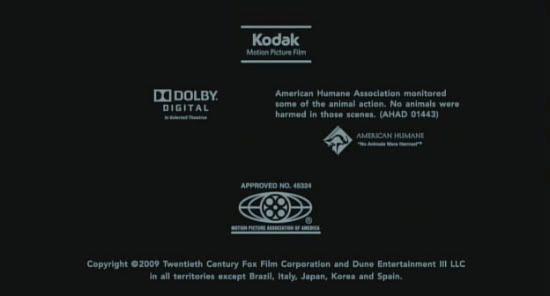
Very reassuring, AHA.
Yeah, but recently in conversation I referenced this detail in the end credits, so I've decided it probably needs to exist somewhere on the interwebs:
Very reassuring, AHA.
04 September 2010
THE LITTLE THINGS: Eagle vs Shark (Taika Waititi, 2007)
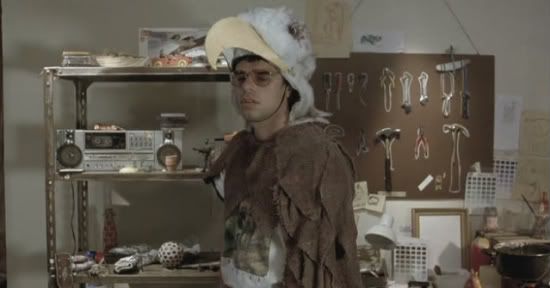
This level of character background detail is why I love this movie.
(Well, y'know, among other things.)
03 September 2010
THE LITTLE THINGS: Spun (Jonas Åkerlund, 2002)
...Speaking of meth!
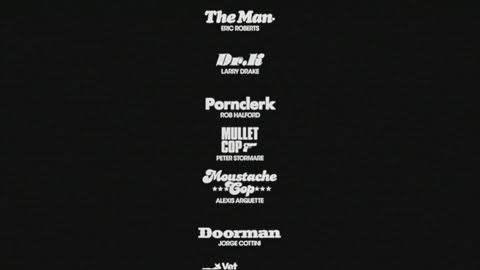
(Cos it's about a bunch of tweakers.)
Yeah, the use of fonts in the credits is a little funny, but other than that all the film really succeeds at is making everybody look gross. Which I guess is good...?
(Cos it's about a bunch of tweakers.)
Yeah, the use of fonts in the credits is a little funny, but other than that all the film really succeeds at is making everybody look gross. Which I guess is good...?
19 July 2010
THE LITTLE THINGS: Four Lions (Chris Morris, 2010)

I didn't take this, nor have I seen the film as it is not released in the US yet, but oh, Christopher Morris.
04 July 2010
THE LITTLE THINGS: The Matrix (Wachowski Siblings, 1999)
I'd like to point out that I was watching this for a paper, not for personal use.
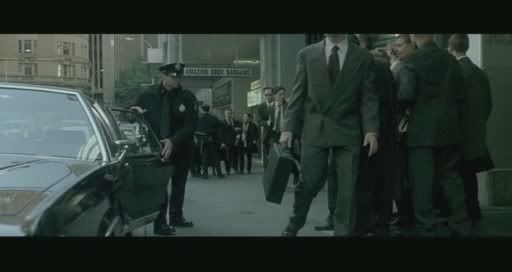
Amazing Book Bargains!
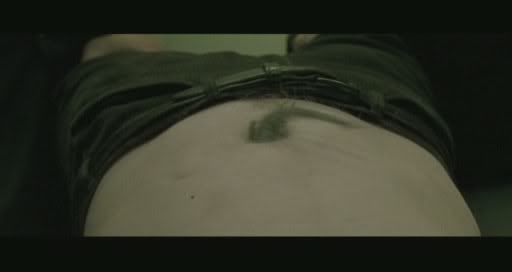
Guess Keanu didn't have time to shave that day...
Amazing Book Bargains!
Guess Keanu didn't have time to shave that day...
THE LITTLE THINGS: Jay and Silent Bob Strike Back (Kevin Smith, 2001)
Jay and Silent Bob Strike Back... uh... Kevin Smith's wife and daughter are in it.
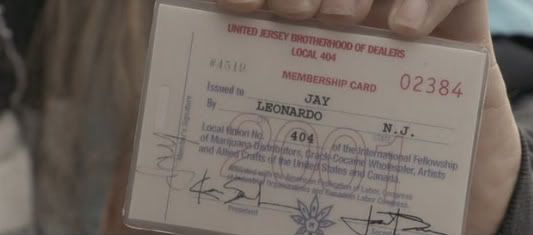
I really like Jay's signature... and the fact that Kevin Smith is president.
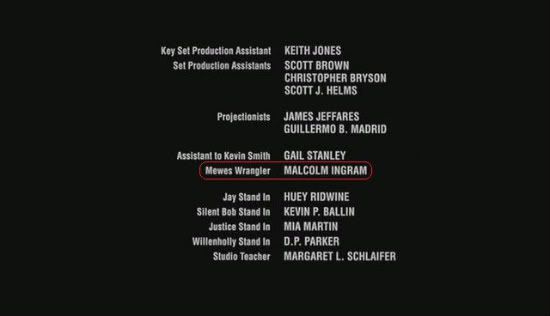
I really like Jay's signature... and the fact that Kevin Smith is president.
14 June 2010
THE LITTLE THINGS: Dogma (Kevin Smith, 1999)
According to the official record, Dogma is the first "swear-friendly" movie I ever watched on my own accord (the little glimpses I caught of whatever child-inappropriate cinema my dad was watching don't really count as I never really saw enough to follow the plotline).
Every "f-bomb" Jay detonated really felt like one to my innocent ten-year-old self, and I thought the term "skeletons in the closet" actually related to osteology. Ah, my youth. The weird thing being that I know I saw Stand By Me long before I ever saw Dogma, and Dogma's like a limp little swear biscuit compared to SBM's rapid-fire cuss-tard.
(Sorry, I keep thinking in a British accent and it's really impeding my ability to metaphorize. All metaphors sound right brilliant in a British accent!)
Yeah, but here's some things you might not have noticed if you don't have the crippling reverse of Attention Deficit Disorder like me:
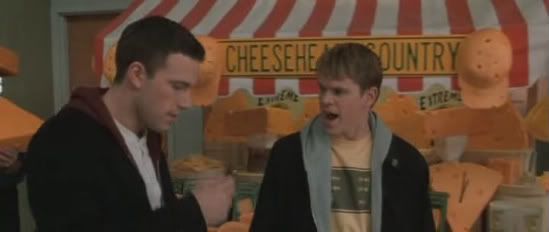
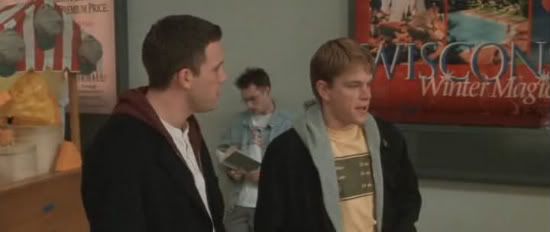
I, too, would hang out in airports if they had booths like that.
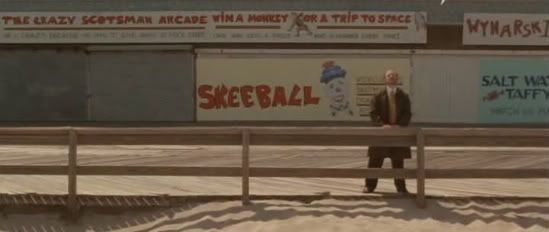
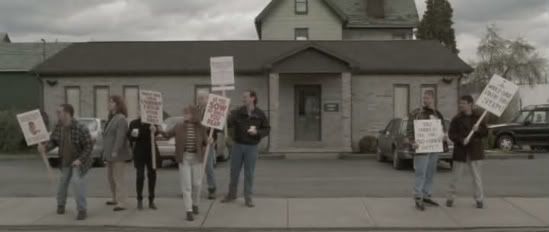
You can't really make out the signs, but I love how contemptuous Steve-Dave and Fanboy look of the other protesters.
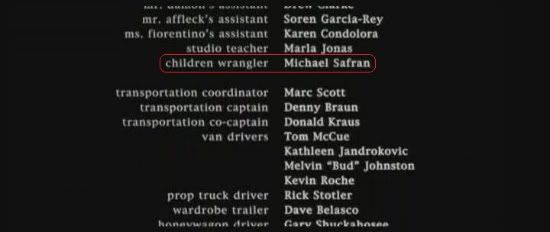
'Nuff said.
Every "f-bomb" Jay detonated really felt like one to my innocent ten-year-old self, and I thought the term "skeletons in the closet" actually related to osteology. Ah, my youth. The weird thing being that I know I saw Stand By Me long before I ever saw Dogma, and Dogma's like a limp little swear biscuit compared to SBM's rapid-fire cuss-tard.
(Sorry, I keep thinking in a British accent and it's really impeding my ability to metaphorize. All metaphors sound right brilliant in a British accent!)
Yeah, but here's some things you might not have noticed if you don't have the crippling reverse of Attention Deficit Disorder like me:
I, too, would hang out in airports if they had booths like that.
You can't really make out the signs, but I love how contemptuous Steve-Dave and Fanboy look of the other protesters.
'Nuff said.
23 May 2010
THE LITTLE THINGS: Chasing Amy (Kevin Smith, 1997)
Chasing Amy is best when it stops trying to force its overly-melodramatic (and possibly GLAAD-offensive?) bi-curious plot-twists to work, and instead just lets itself be silly and fun.
(So when Ben Affleck is not in the frame.)
Here are some funny little things:
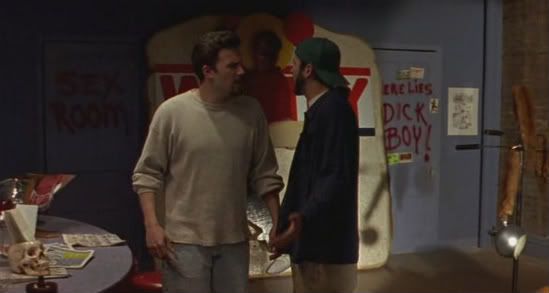
(Re: the doors, but why do young people in movies always seem have weird, expensive-looking sorts of corporate modern art in their overly spacious pads?)
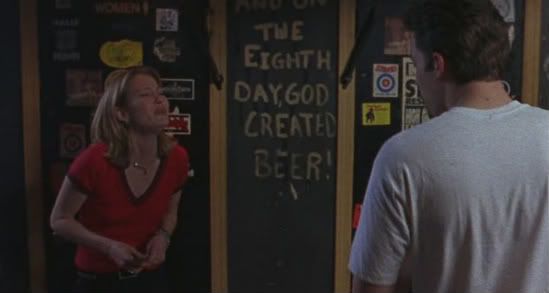
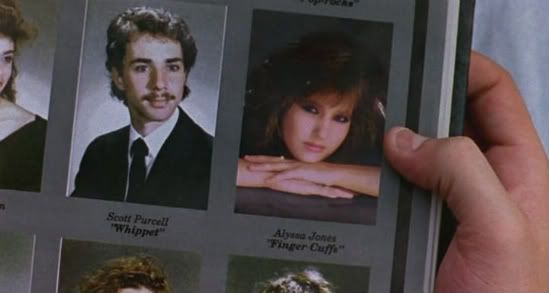
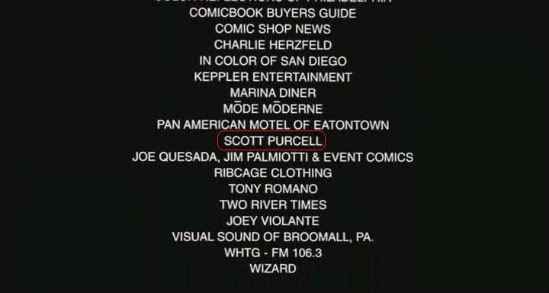
...In the credit "thanks":
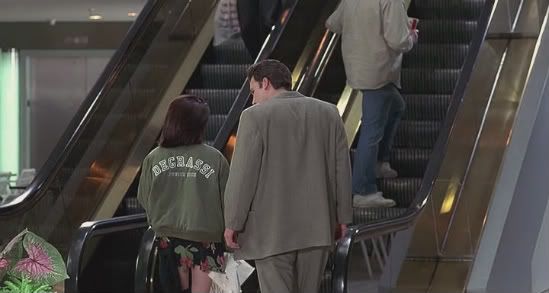
And as a Mallrats corollary:
(There is a direct line of influence between that quote and the three seasons of My Name is Earl I've watched/forced myself through.)
(So when Ben Affleck is not in the frame.)
Here are some funny little things:
(Re: the doors, but why do young people in movies always seem have weird, expensive-looking sorts of corporate modern art in their overly spacious pads?)
...In the credit "thanks":
And as a Mallrats corollary:
(There is a direct line of influence between that quote and the three seasons of My Name is Earl I've watched/forced myself through.)
11 May 2010
THE LITTLE THINGS: Mallrats (Kevin Smith, 1995)
I want that jacket, and one of these hats:
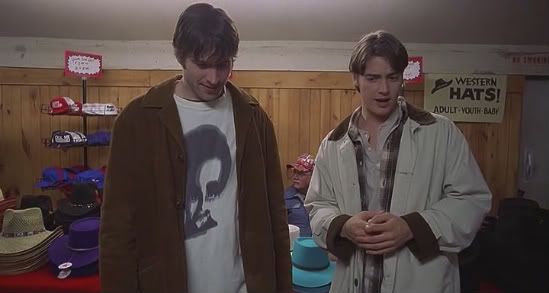
(Baby-size.)
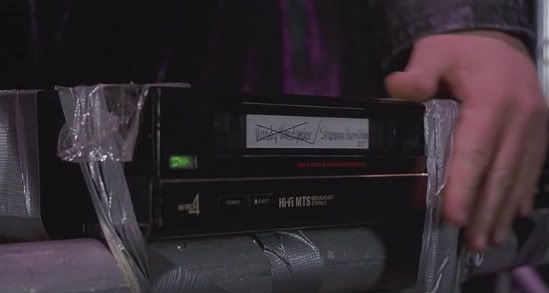
(The hilarity stemming from how "Woody Woodpecker" sounds more like a porno than "Shannon Hamilton.")
09 May 2010
THE LITTLE THINGS: Zodiac (Fincher, 2007)
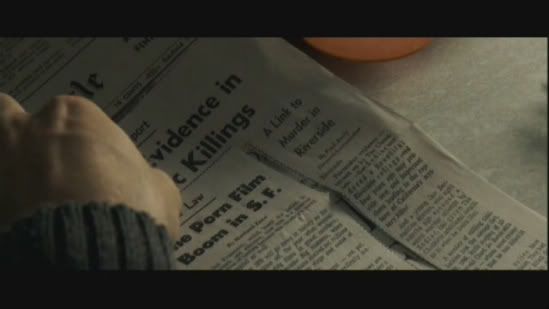
I was wondering if this is a duplicate of that actual newspaper edition, and whether David Fincher or the production designer or art/set decorators would go to that much trouble, and then I realized that most people are not as obsessive about the little things as I am, and that most people would not care about this, or even think to.
Also, I totally forgot a McPoyle is in this movie!
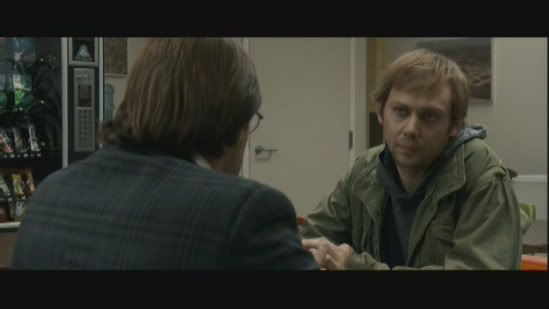
I totes IMDbd him after seeing it in theatres, too. But I hadn't started watching Always Sunny yet and I guess he hadn't been in anything of note by that point to check out from the library.
And some things that I noticed in the credits, cos I read the credits:
26 April 2010
THE LITTLE THINGS: Queen Christina (Mamoulian, 1933)
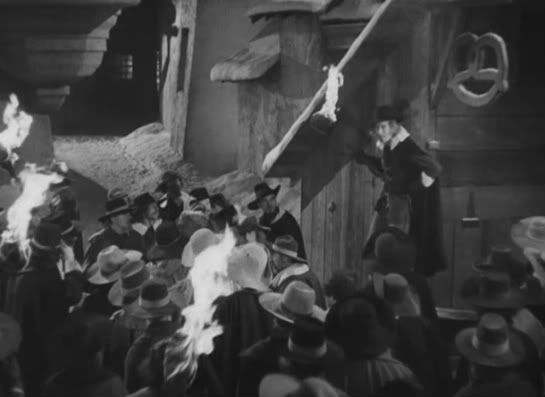
Nowhere for an angry mob to gather quite like the pretzel store...
23 April 2010
YOU SHOULD KNOW: Allison Jones (casting director)
NOTE: I HAVE NO AFFILIATION WHATSOEVER WITH ALLISON JONES. I HAVE NO IDEA HOW TO CONTACT HER. THIS IS JUST A FANPOST, AS SOMEONE WHO APPRECIATES THE WORK SHE'S DONE.
Do you watch television, or movies? Do you have good taste in the aforementioned media? If so, then you've probably seen something cast by Allison Jones. She's kind of amazing.
Allison has been in the casting industry since at least 1985, that year working in the casting department of Golden Girls and as the casting director for a comedy horror movie, Hard Rock Zombies, and on the show Family Ties.
Yeah, yeah, those are things I'd probably choose to read a years-old Us Weekly rather than watch if they were playing in the waiting room of the plasma donation center that is currently my only source of income, but Family Ties? That's fracking Michael J. Fox right there. And though Allison didn't work on Ties during its first season, that kind of golden casting genius clearly rubbed off on her.
Ms. Jones worked in casting steadily through the eighties and nineties, nothing really that notable (some Fresh Prince episodes, the Roswell pilot, mostly NBC stuff), and then, in 1999, she hit awesome. She worked as the casting director for the pilot on the network-axed but now-cult-classic Freaks and Geeks. Yes, the writing and directing of this show float above us at uncommonly high levels of astounding, but would this show's box-set be in my DVD collection if it were not for the actors portraying these beloved characters? Maybe, but a person can hardly imagine Bill Haverchuck without Martin Starr, or Ken Miller without Seth Rogen. And essentially everyone on this program went on to do other mind-bendingly fantastic work. Even Stephen Lea Shepphard (Harris Trinsky) went on to be in The Royal Tenenbaums. Or just think about all the guest stars in Freaks and Geeks -- Jason Schwartzman, Ben Foster, Rashida Jones, Lizzy Caplan -- who after F&G went on to prove they were all kinds of wonderful. In 2000, Allison Jones and casting executives Coreen Mayrs and Jill Greenberg won an Emmy for "Outstanding Casting for a Comedy Series" on Freaks and Geeks, and they deserved that hunk of metal.
Since Freaks and Geeks, Allison has continued her television track-record of casting bad-assery, being Emmy-nominated for "Outstanding Casting for a Comedy Series" for the epic likes of Curb Your Enthusiasm (2004, 2006, 2008), Arrested Development (2005), United States of Tara (2009, cast the pilot), and The Office (2009). She is well-known for her ability to help put together realistic ensembles with phenomenally good chemistry. A frequent collaborator with Judd Apatow and others, Allison Jones has also worked on Undeclared and Parks & Recreation, and the movies Superbad, Borat, Knocked Up, Hot Rod, and The 40 Year Old Virgin, among many more. If you haven't seen all of this shit, then... shame on you and your family, man.
People want to be on The Office
But awards aside, Allison Jones has a fantastic eye. And not just, you know, for the spectacular leads she's scrounged up for pilot season, but for the little parts, too.
In an interview about her trek to stardom, Jenna Fischer (Pam on The Office) mentions that it was Allison who really propelled her career into existence:
So, how did I get The Office? Spin City was cast by Allison Jones... She became a fan of mine through a series of auditions. I kept going into her office year after year auditioning for different things. I got some and not others but she kept bringing me back... Allison remembered me when it was time to cast The Office. She called me to audition and I finally got the part.
Loyalty. Appreciation. Allison Jones seems to like the talented actors she casts as much as we do. When she finds someone good for a role, even just a tiny one, she'll bring them back if they're deserving. Jenna Fischer is on The Office and was on Spin City, but remember how she was also on Undeclared as that sorority girl? Or how Rashida Jones was Karen Scarfolli on Freaks and Geeks, and Karen Filippelli on The Office, and Ann Perkins on Parks & Recreation? Dude, whenever Allison Jones casts someone, you kind of know that their autograph will be worth hundreds on eBay in a couple of years.
So the next time you're considering a TV show or a movie with unfamiliar stars, maybe look further than the director when deciding whether to watch it. Allison Jones just may have cast it into excellence.
Do you watch television, or movies? Do you have good taste in the aforementioned media? If so, then you've probably seen something cast by Allison Jones. She's kind of amazing.
Allison has been in the casting industry since at least 1985, that year working in the casting department of Golden Girls and as the casting director for a comedy horror movie, Hard Rock Zombies, and on the show Family Ties.
Yeah, yeah, those are things I'd probably choose to read a years-old Us Weekly rather than watch if they were playing in the waiting room of the plasma donation center that is currently my only source of income, but Family Ties? That's fracking Michael J. Fox right there. And though Allison didn't work on Ties during its first season, that kind of golden casting genius clearly rubbed off on her.
Ms. Jones worked in casting steadily through the eighties and nineties, nothing really that notable (some Fresh Prince episodes, the Roswell pilot, mostly NBC stuff), and then, in 1999, she hit awesome. She worked as the casting director for the pilot on the network-axed but now-cult-classic Freaks and Geeks. Yes, the writing and directing of this show float above us at uncommonly high levels of astounding, but would this show's box-set be in my DVD collection if it were not for the actors portraying these beloved characters? Maybe, but a person can hardly imagine Bill Haverchuck without Martin Starr, or Ken Miller without Seth Rogen. And essentially everyone on this program went on to do other mind-bendingly fantastic work. Even Stephen Lea Shepphard (Harris Trinsky) went on to be in The Royal Tenenbaums. Or just think about all the guest stars in Freaks and Geeks -- Jason Schwartzman, Ben Foster, Rashida Jones, Lizzy Caplan -- who after F&G went on to prove they were all kinds of wonderful. In 2000, Allison Jones and casting executives Coreen Mayrs and Jill Greenberg won an Emmy for "Outstanding Casting for a Comedy Series" on Freaks and Geeks, and they deserved that hunk of metal.
Since Freaks and Geeks, Allison has continued her television track-record of casting bad-assery, being Emmy-nominated for "Outstanding Casting for a Comedy Series" for the epic likes of Curb Your Enthusiasm (2004, 2006, 2008), Arrested Development (2005), United States of Tara (2009, cast the pilot), and The Office (2009). She is well-known for her ability to help put together realistic ensembles with phenomenally good chemistry. A frequent collaborator with Judd Apatow and others, Allison Jones has also worked on Undeclared and Parks & Recreation, and the movies Superbad, Borat, Knocked Up, Hot Rod, and The 40 Year Old Virgin, among many more. If you haven't seen all of this shit, then... shame on you and your family, man.
People want to be on The Office
But awards aside, Allison Jones has a fantastic eye. And not just, you know, for the spectacular leads she's scrounged up for pilot season, but for the little parts, too.
In an interview about her trek to stardom, Jenna Fischer (Pam on The Office) mentions that it was Allison who really propelled her career into existence:
So, how did I get The Office? Spin City was cast by Allison Jones... She became a fan of mine through a series of auditions. I kept going into her office year after year auditioning for different things. I got some and not others but she kept bringing me back... Allison remembered me when it was time to cast The Office. She called me to audition and I finally got the part.
Loyalty. Appreciation. Allison Jones seems to like the talented actors she casts as much as we do. When she finds someone good for a role, even just a tiny one, she'll bring them back if they're deserving. Jenna Fischer is on The Office and was on Spin City, but remember how she was also on Undeclared as that sorority girl? Or how Rashida Jones was Karen Scarfolli on Freaks and Geeks, and Karen Filippelli on The Office, and Ann Perkins on Parks & Recreation? Dude, whenever Allison Jones casts someone, you kind of know that their autograph will be worth hundreds on eBay in a couple of years.
So the next time you're considering a TV show or a movie with unfamiliar stars, maybe look further than the director when deciding whether to watch it. Allison Jones just may have cast it into excellence.
21 April 2010
THE LITTLE THINGS: Harold and Kumar Go to White Castle (the french subtitles)
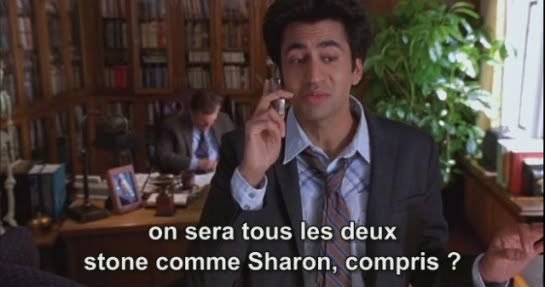
(Can a post really even get more pretentious than this?)
Subscribe to:
Posts (Atom)